Hello my dears,
I hope you are all well.
As promised, here is the second part about the biggest differences I have noticed here in Tanzania so far. Things that I notice, experience and see, and which are simply very different compared to Germany. Once again, everything I write below is based on my personal impressions and experiences, as well as conversations with locals. Much of it certainly does not apply to Tanzania as a whole, but mainly to my region. And in the same way, my thoughts on Germany only refer to what I myself know and have experienced so far.
And soon there will be another ‘typical’ blog entry, with lots of pictures and stories from my everyday life.
- My house = your house
So far, I haven’t seen any doorbells anywhere. If you want to visit someone, you sometimes call ahead, but most of the time you just knock briefly, say ‘hodi hodi’ and then simply walk in. At first, this took a lot of effort on my part, because this spontaneous entering of houses is completely unimaginable in Germany. It’s even more surprising when you’re relaxing on the sofa and suddenly someone is standing in your kitchen.
Here, it’s just part of everyday life and creates a special feeling of closeness and trust. I’ve gotten used to it now and am happy about every visit, whether announced or not.
2. Time
In Tanzania, the week officially begins on Saturday. In Kiswahili, Saturday is called ‘Jumamosi,’ meaning ‘first day of the week.’ This means that the week starts with the weekend. However, it depends on who you talk to. For many people who go to work, the week still starts on Monday.
This way of counting comes from the Arabic influence on language and culture. ‘Juma’ means week and refers to Friday, which plays a special role. From there, the days are simply counted on.
The time is also different in Kiswahili. There is what is known as Swahili time. It uses a 12-hour system and is always six hours behind our time. This means, for example, that 7 a.m. German time is 1 p.m. here.
This can sometimes be quite confusing. It is often not entirely clear whether English time or Swahili time is meant. Especially when someone says ‘am’ or ‘pm’ but is actually using Swahili time. Some people are not even aware that there is a six-hour difference, even though their clocks are set to English time.
The reason for this is quite simple: the daily routine here is based on sunrise and sunset. Since it almost always gets light around six o’clock near the equator, the day simply begins at this time in Swahili time.
3. Health and social welfare system
The health and social welfare system in Tanzania differs in some respects from what we are familiar with in the Germany. Health insurance is available to everyone. Contributions are either deducted directly from salaries or people take out private health insurance, which is usually paid for once a year. Nevertheless, there are many people who cannot afford this insurance and therefore have to pay for medical treatment themselves. This can quickly become expensive and poses a major challenge for many.
As an alternative, there are state hospitals and health centres where treatment is offered free of charge or at very low cost. Medical care there is usually more basic than in private clinics and, especially in rural and poorer regions, is not always available everywhere. At the same time, the government is working to further expand the state health insurance system. The long-term goal is to provide health insurance for everyone.
There are also state systems for pensions and social security. For employees, there are pension funds such as the NSSF and the PSSF, into which contributions are paid during their working life. In the event of accidents at work or loss of employment, support can be provided by the Workers Compensation Fund under certain conditions.
The emergency call system is very different from that in Germany. There is an emergency number, but it does not work reliably. I recently tried to call this number with a friend, but it was unavailable. In rural areas, it works even less frequently than in larger cities. This also means that in the event of an accident in the countryside, you are heavily reliant on yourself and your relatives. In an emergency, you can only hope that help from family or those in your immediate vicinity is not far away.
4. Water
In Germany, clean, delicious drinking water comes out of the tap at any time, something I only really became aware of here. In Tanzania, you can’t just drink tap water. I use bottled or boiled water for everything, even brushing my teeth or washing vegetables. Even when cooking rice, we are sometimes cautious and prefer to use drinking water because tropical diseases and infections can be transmitted via tap water despite boiling. This makes many things more complicated and shows me once again how privileged we are to have a water supply at home. After a few days of rain, the water pipes can become blocked, causing dirty water to come out of the tap.
5. Image of women
Here in Tanzania, I have noticed how strongly traditional role models still prevail. In society, a woman is always subordinate to a man and must show him respect at all times.
A man is allowed to have several wives at the same time, because here the saying goes: a man can impregnate several women at the same time, but a woman can only be pregnant by one man.
Clothing also plays an important role: women rarely wear trousers and must always dress modestly. In addition, they run the household, look after the children and work, acting as family protector, daily manager and employee all in one. Before the wedding, a man must also pay money to a woman, and in some regions cows or goats as well, depending on what the woman’s family wants.
In comparison, Germany seems like a different world: equality is supported by law, and women make their own decisions about relationships, clothing and professional life. Of course, not everything is perfect here either, but the differences have become very clear to me here.
6. Payment
What immediately struck me here was that digitalisation plays virtually no role in payments. Almost everything is still done with cash. There is M-Pesa, a system that allows you to send money to people via their telephone number, but to use it, you first have to load cash onto your mobile phone at a kiosk. Card payments are rare, and then mostly only in large cities, and even there mainly in European or tourist districts. Compared to Germany, where contactless payment is possible almost everywhere, it feels really ‘analogue’ here, and you immediately notice how much cash dominates everyday life.
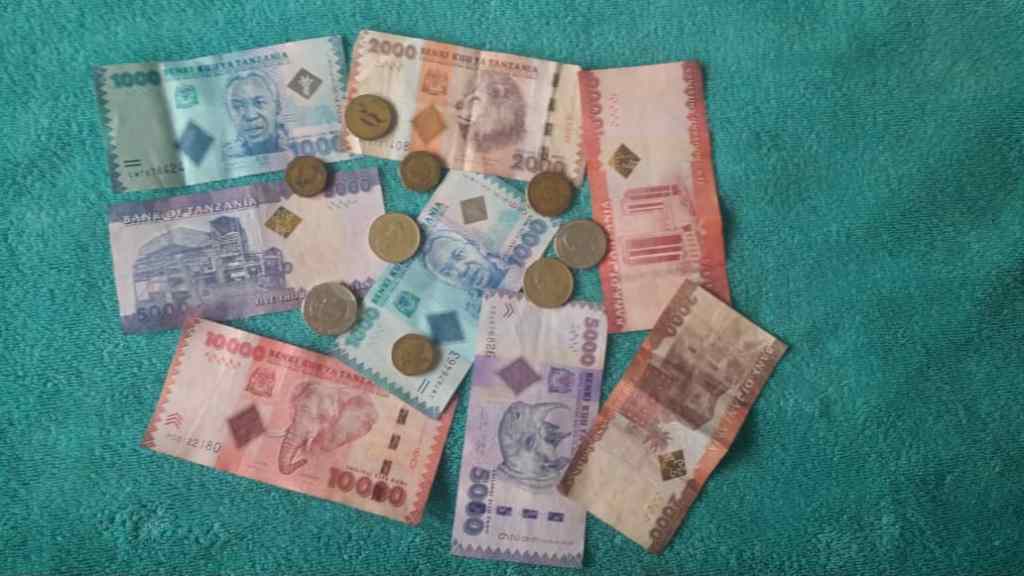
In addition, the currency here is very different from that in Germany. 10,000 Tanzanian shillings are just over 2.5 euros, and that’s the largest note. The smallest coin is 200 shillings, which cannot be expressed in euros or cents. When you go to the bank, you can withdraw a maximum of 400,000 TZS at a time, which is about 140 euros. That’s enough to last a long time, but you’re constantly walking around with a wad of cash, which feels really strange. Once, when I had to pay a bill for two million shillings at the hospital, I had to go to the bank five times and use several different banks, otherwise I wouldn’t have been able to get enough cash.
But… the banknotes here are incredibly beautiful.
7. Climate
The climate here in Tanzania is completely different from that in Germany. In my region around Rulenge, Ngara in Kagera district, the seasons are mainly marked by the rainy and dry seasons. We are currently in the short rainy season, and it actually rains really heavily for 1–3 hours almost every day, a downpour that we hardly ever experience in Germany. Before and after that, the sun shines reliably again as if nothing had happened. The rain just comes, sometimes at really inconvenient moments, and there is no warning. During the day, the temperature is currently around 25 degrees, sometimes it is very humid, oppressive or hot, but at night it cools down significantly. When it rains for a long time, it can even get really cold. (A chilly 12 degrees, haha.) Nevertheless, you can actually see the sun every day.
It’s completely different in Dar es Salaam on the coast: there, temperatures are around 30 degrees practically all year round, rain falls irregularly, and the air is often humid and tropically warm.
I am really glad that I don’t need a winter coat, scarf, hat and gloves in December, around Christmas, but can simply walk around outside in a T-shirt and skirt. My heart goes out to all of you when I sometimes look at the weather forecast in Germany and see -4 degrees.
8. Faith
Faith plays a much greater role in everyday life here in Tanzania than it does in Germany. It is lived out completely within the community. It consists of communal prayer, church attendance, religious festivals and rituals. I have noticed that the customs here are sometimes different from what I am used to in Germany. Many people pray for absolutely everything: before eating, before school, before every car journey, and they attend mass regularly, but do not receive the Eucharist. This seems a little unusual to me.
One phrase I have heard particularly often here is ‘You have my prayers’. In German, we would express something like this more as ‘I am thinking of you’ or ‘I believe in you’. Nevertheless, it is impressive to see how much faith shapes everyday life here and how strongly it connects people.
And with that, I’ll conclude the Germany vs. Tanzania series for now. There are indeed many differences, but that’s what makes it so exciting.
Continue to take good care of yourselves. The next blog entry will be in the new year. 😍
So I’d like to say: Heri ya Krismasi na mwaka mpya wenye furaha! – Merry Christmas and a Happy New Year.
Have a good time and enjoy the holidays.
All the best to you and big hugs❤️
All my love, Joana


Kommentar verfassen